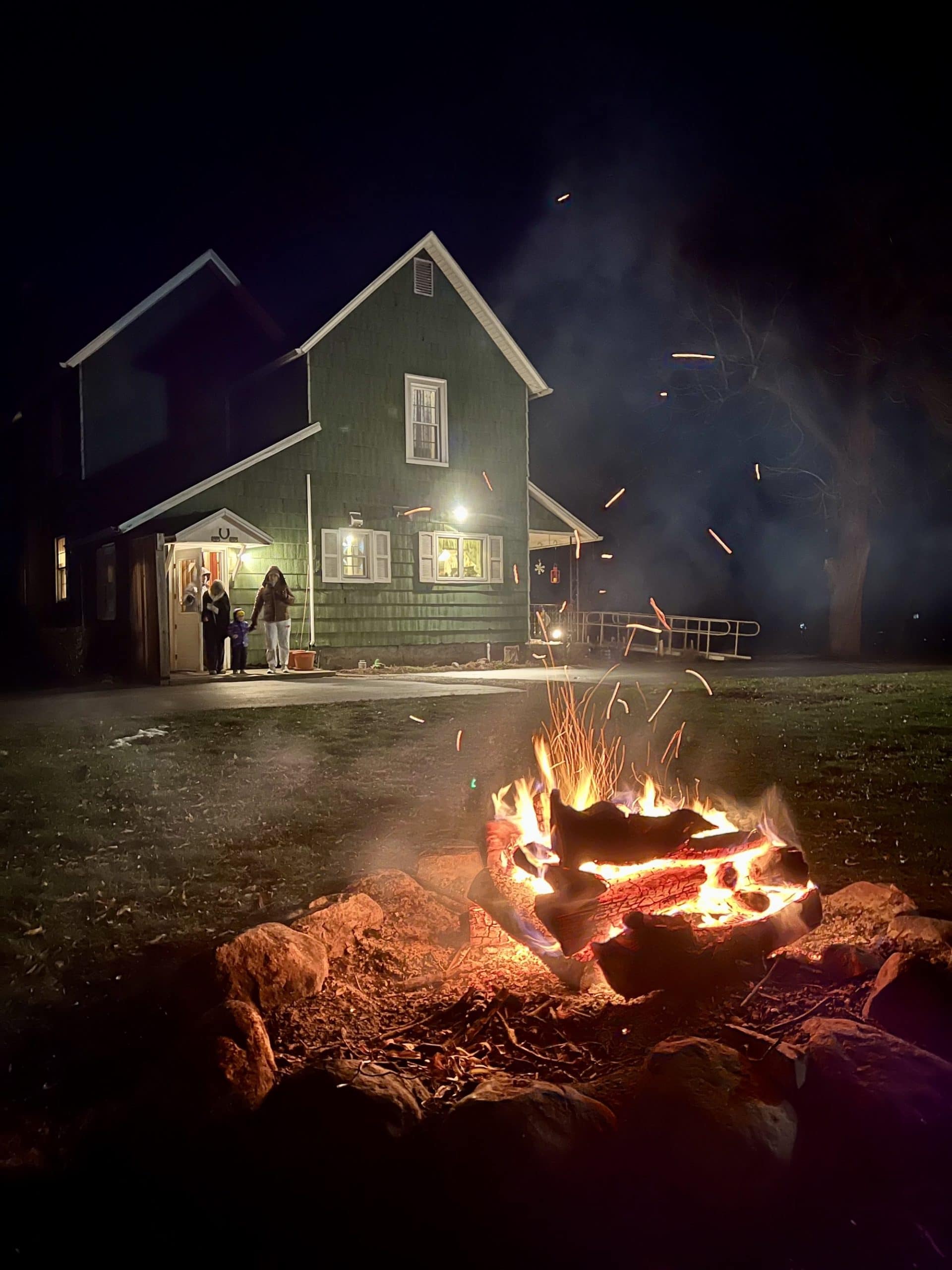
What the fuck are we doing out here? The thought had crossed my mind a couple dozen times since I took a chainsaw to several towering pines and ornamental plums, filled my grandparents’ beloved yard with holes and buried flimsy sticks that came with warning labels about “fireblight” and “perennial canker” and “scab.”
But this time I had dragged my wife and toddler and my poor grieving mom out into a 26-degree night to toss some paper into a bonfire while my uncle worried I was going to burn down the house, the garage and, apparently, his car.
I had it in my head that, at the end of a hardscrabble year when my dad died and my family tried to pick up the pieces he left and fit them together in some new way, it’d be a good idea to follow in the footsteps of the great civilizations of yore and throw a little shindig. On the winter solstice. The darkest day of the year.
Humans invent rituals to survive winter. Fires. Feasts. Candles in the dark. We pretend we’re celebrating the return of the light, but mostly we’re trying to convince ourselves we’ll make it that far.
Yuletide. Saturnalia. Soyal. St. Lucia’s Day. Midwinter. The gist is, hey, it doesn’t get much worse than this. Let’s look toward the light.
After pillaging their Wikipedia pages, I came up with a plan: Drink apple brandy for courage, fill mugs with hot cider, write down what we wanted to let go of and then … burn it in the fire. Easy enough.
I didn’t call it off as the mercury dropped. Not when it snowed in December, not when it melted and turned the lawn to mush. Not when the wind gusts began shooting sparks across the place like a busted particle accelerator.
Twenty feet away, the apple trees were laughing at us. When humans hide inside, pack on a few extra pounds (“chubbing up for the season,” as I told a friend) and complain endlessly about the 30 seconds it takes us to get from the back door to our car, trees drop a few leaves and start plotting their next big thing.
Trying not to kill the plants I’ve spent hundreds of dollars on has forced me to learn a little plant science. And after surviving my first winter back in Buffalo only to lose my old man near the end of it, one concept kept following me around.
Senescence.
Turns out, trees don’t die off in the winter. When the cold arrives, they pull their water and nutrients down into their roots, tucking the vulnerable parts of themselves safely underground, insulated by the earth. That retreat changes everything.
In cold climates, trees don’t just regrow leaves in the spring. The sugars they stored through the winter help fuel that first rush of growth — buds swelling, sap rising, leaves unfurling. In places where the growing season is short, that work happens quickly and decisively. The rings they lay down are often tighter. The wood can be denser. The growth comes in seasons, not in a steady hum. The trees are more resilient.
Have you ever met anyone from Buffalo? This should sound familiar.
Winter, it turns out, is not the absence of growth. Winter is the precondition for growth.
Knowing this doesn’t make January feel any warmer.
In the more agreeable months, I walk for miles with my dog — around the Medina limestone spires and the hulking wreck of the Richardson Olmsted Campus; past BreadHive, where I take deep breaths and smile at the bakers in the quiet hope of one day being handed a loaf; through Bidwell Park, where without sidewalks my dog forgets how to walk in a straight line. As the pavement slowly claims my shoes, my mind wanders. Problems loosen. Solutions surface. Thoughts stretch their legs.
We were put on this earth to fart around, Kurt Vonnegut once said, and I’m happy to honor him.
Winter shuts down the wandering.
Snow and ice keep me off the roads and sidewalks, so I steal away exercise on a stationary bike, watching monster-of-the-week episodes of “The X-Files” while the same small problems circle the room. With nowhere to go, they find purchase. They grow. They feel impossible.
I need the refresh of the great outdoors.
I am out in the snow, losing feeling in my toes, checking on my apple trees as they enter their second growing season.
Two held onto their leaves — the Harrisons, the tallest ones. They’re from New Jersey. Typical. They move to New York and act like they’ve always been here.
Two form upside-down bells that look a bit like shredded umbrellas — the Liberties. Some metaphors write themselves.
One is small but stoic — the Dabinett. Its sibling was killed by some toothsome thing. Don’t tell the others it’s my favorite.
With nothing to do, I wonder what they’re up to in these winter months and fall down a path of internet research.
Senescence.
Not sleeping. Not dying. Biding.
Saving everything for what comes next.
The last 14 years of my life were mostly without seasons. In Florida there’s summer and there’s kinda-summer, punctuated by the occasional sweater day and the quiet certainty the next hurricane — or rum runner — is minutes away.
Florida offered abundance without urgency. New York imposes urgency through scarcity.
In Florida, I could always do it later. In New York, later is not guaranteed.
Seasons insist on participation.
Part of becoming an adult is realizing that the future is not an abstract concept. It is a shrinking window.
The winter takes away your exercise. Someone cuts down your trees. And then, out of nowhere, your fucking dad dies.
I’ve been devouring that knowledge and checking the floor for crumbs, trying to make it feel less sudden.
Later stopped feeling theoretical.
Loss has a way of pulling the past closer. I’ve been thinking a lot about childhood. Partly because a little boy now lives in my house who looks uncannily like I once did. Partly because the cast of my childhood has grown smaller — my mom, my brother, a handful of voices still on the line.
Nostalgia gets a bad rap. Millennials are famous for romanticizing plastic toys and extinct snack foods. But I once read that nostalgia is what happens when human nature gets torn up by the roots.
I’ve also been thinking a lot about roots.
We made a slow, icy drive home from Gasport on Dec. 26, one last round of Christmas music playing quietly in the car as my toddler slept in the back seat.
Somewhere along the drive I found myself thinking about the old general in “White Christmas” — the moment he realizes he hasn’t been forgotten. Then the song: We’ll stay with the old man.
That landed differently this year.
A little later, another lyric surfaced.
What comes before “walking in a winter wonderland”?
To face unafraid the plans that we made.
It was there all along.
The toddler woke up when we pulled into the driveway. I carried him inside and he said he wanted to go straight to bed. But not without me. My wife sat with him while I unloaded the car, cold air pushing through the layers of my coat.
When I was done, I climbed in beside him, pulled him close and turned off the lights. I thought he’d already drifted off.
Then, in a tiny voice, he said, I don’t want to close my eyes.
Me either, boy.